
Can My Business Stay Open During Water Damage Restoration?
Posted August 12, 2026
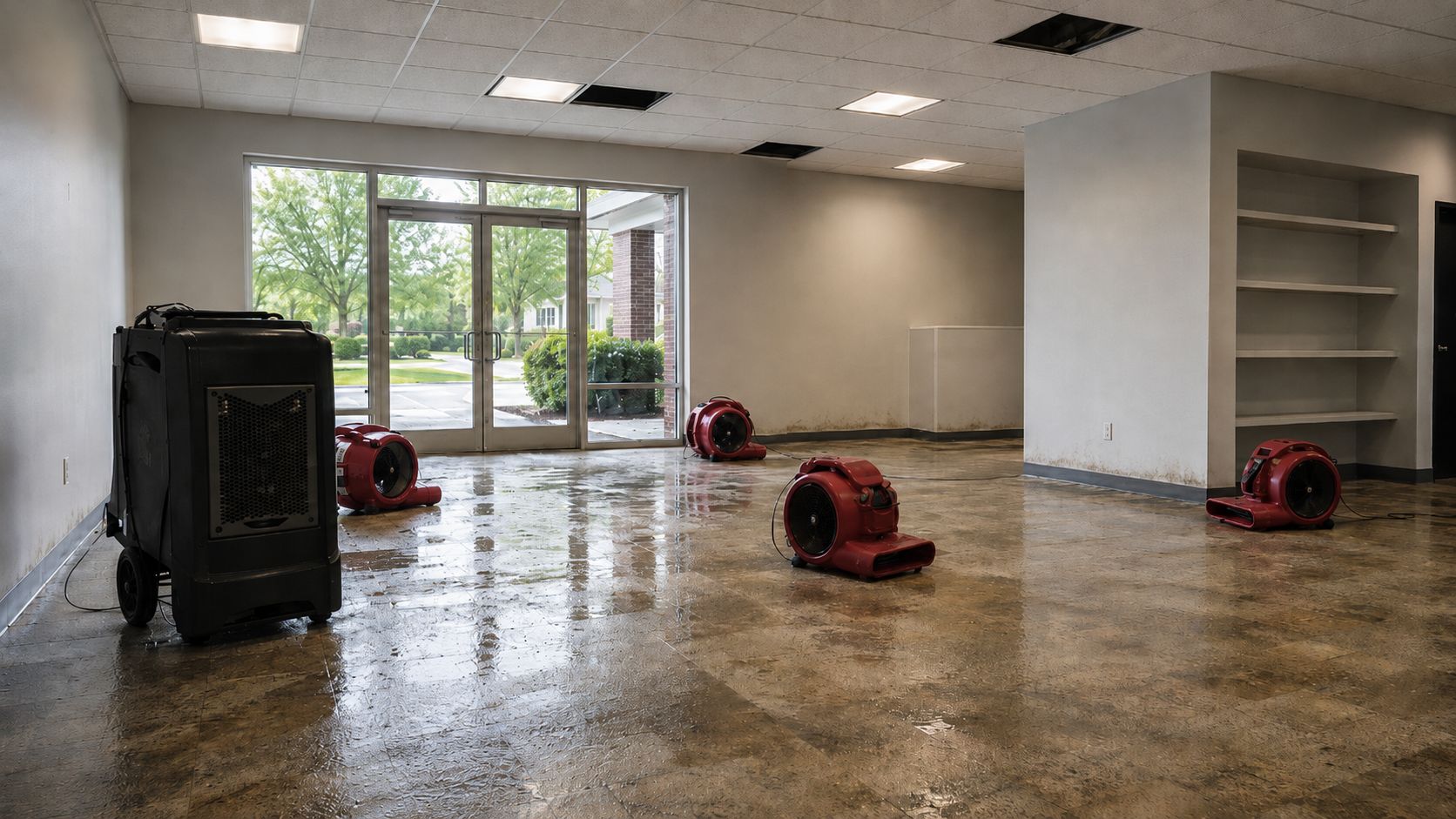
Water damage does not automatically mean your entire business has to close.
In some cases, unaffected parts of a commercial building can remain operational while water damage restoration takes place elsewhere. In other situations, contamination, electrical hazards, damaged building systems, structural concerns or widespread moisture can make temporary closure or restricted access necessary.
The important question is not simply whether there is water in the building. It is whether employees, customers and tenants can safely use the unaffected areas while proper restoration continues.
If water is actively spreading through your commercial property, EMRG provides 24/7 emergency water damage restoration across Canada. Call 1-844-344-3674 for immediate assistance.
Can a Business Stay Open During Water Damage Restoration?
Sometimes.
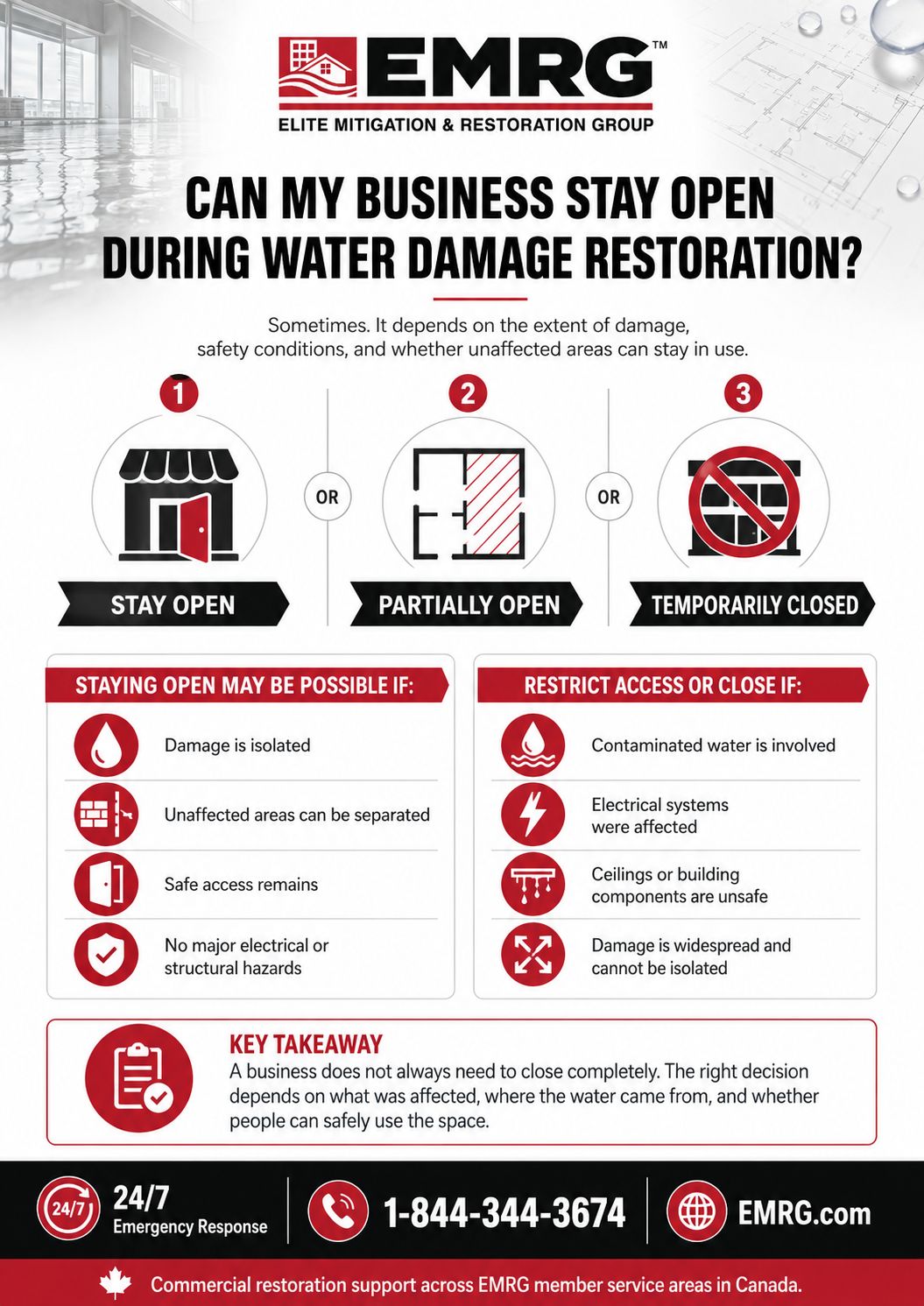
There are generally three possible scenarios after commercial water damage:
- The business remains open while a small affected area is isolated.
- Some areas continue operating while damaged sections are restricted.
- The building temporarily closes because the loss affects safe occupancy or critical operations.
Which option is appropriate depends on the actual conditions inside the property.
A small plumbing leak confined to one office can be very different from a sewer backup across a restaurant, water entering an electrical room or a major pipe failure affecting several floors.
A professional assessment can help determine how far the water has travelled, what materials and systems are affected and whether the damage can be safely separated from normal business activity.
What Determines Whether Your Business Can Stay Open?
Several factors matter when deciding whether commercial operations can continue.
Where Did the Water Come From?
The source of the water is one of the first considerations.
A recent release from a potable water supply line presents different concerns than water from:
- A sewer backup
- Overland flooding
- A backed-up drain
- A toilet overflow involving contamination
- An unknown source
Floodwater can contain sewage, chemicals and other harmful substances. The Canadian Centre for Occupational Health and Safety advises avoiding floodwater where possible and restricting access until appropriate safety assessments have been completed.
When potentially contaminated water is involved, keeping the affected area occupied simply to avoid disrupting operations may create unnecessary risk.
How Far Has the Water Travelled?
The visible wet area may not represent the full extent of the loss.
Water can move:
- Beneath flooring
- Behind baseboards
- Into wall cavities
- Through ceilings
- Into adjacent rooms
- Down to lower floors
- Around cabinetry and fixed equipment
EMRG members use moisture assessment and monitoring to help determine the actual affected area rather than relying only on what looks wet.
This information can also help determine whether the loss can be isolated from the rest of the business.
Were Electrical Systems or Equipment Affected?
Water and electricity require immediate caution.
If water has reached outlets, electrical panels, wiring, machinery or powered equipment, access to the area should be restricted until the electrical risk has been properly assessed.
Canadian flood-safety guidance advises treating electrical wiring as live unless verified otherwise and avoiding electrical equipment while wet or standing in water. Equipment and electrical systems affected by floodwater should be inspected by a qualified professional before being used again.
Do not assume equipment is safe simply because the standing water has been removed.
Are There Structural or Overhead Hazards?
A wet floor is not the only concern after a significant water loss.
Saturated ceilings, damaged drywall, falling materials or compromised building components can make an area unsafe to occupy.
Employees and customers should be kept away from sagging ceilings or visibly damaged areas until the condition has been assessed.
What Kind of Business Uses the Space?
The same amount of water damage can have very different consequences depending on the property.
Consider the difference between:
- An office with an unused meeting room affected by a leak
- A restaurant with water in a food preparation area
- A retail store with affected customer aisles
- A warehouse with wet inventory and powered equipment
- A medical facility with sensitive treatment areas
- A manufacturing plant with damaged machinery
- A multi-tenant commercial building with water travelling between units
The restoration plan has to account for how the building is actually used, not only how much water is present.
When Should a Business Close or Restrict Access?
There is no single rule that requires every business experiencing water damage to close completely.
However, access may need to be restricted when conditions include:
- Sewage or potentially contaminated water
- Electrical hazards
- Sagging or heavily saturated ceilings
- Suspected structural damage
- Unsafe entrances, exits or walking surfaces
- Water affecting important mechanical systems
- Widespread damage that cannot be isolated
- Restoration activities that create hazards within occupied areas
Following a flood, CCOHS recommends restricting access until safety assessments are completed and confirming that a building is structurally safe before people return.
A localized loss is different. If one section can be safely isolated, closing an entire commercial property may not always be necessary.
Can Part of a Commercial Building Stay Open During Restoration?
In some situations, yes.
Commercial water damage restoration can sometimes be planned around partial occupancy.
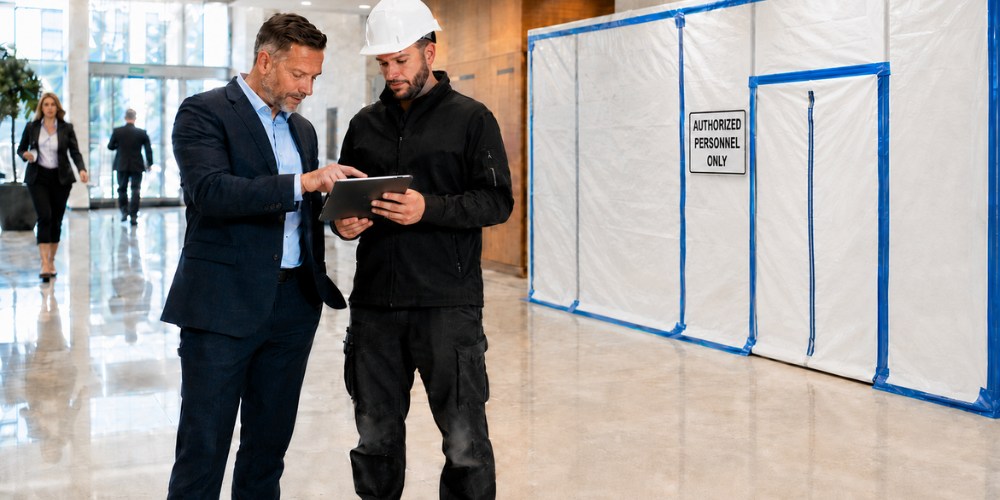
For example, a restoration team may be able to establish separate work areas so that unaffected portions of the building remain accessible.
Depending on the property and loss, this can involve:
- Restricting access to damaged areas
- Creating clearly defined restoration work zones
- Protecting unaffected inventory or equipment
- Maintaining safe routes for employees or tenants
- Scheduling disruptive work outside normal operating hours
- Prioritizing areas that are important to business operations
- Coordinating restoration equipment around occupied spaces
This is one reason an early commercial assessment matters.
The decision does not have to be limited to “fully open” or “completely closed.” Sometimes the most practical plan is to restore the building in stages while keeping safe, unaffected areas in use.
EMRG members regularly work with commercial and multi-unit properties where access, occupants, equipment and business operations all have to be considered as part of the restoration plan.
Can Employees Work in the Building During Restoration?
Employees may be able to work in unaffected areas if site conditions support continued occupancy.
However, employers still have workplace health and safety responsibilities.
Canada has federal, provincial and territorial occupational health and safety jurisdictions, and the specific requirements that apply depend on the workplace and location. Canadian occupational health and safety legislation generally places responsibility on employers to protect worker health and safety.
Practical concerns during water damage restoration can include:
- Wet or slippery walking surfaces
- Electrical hazards
- Contaminated water
- Noise from restoration equipment
- Hoses and power cords
- Dust or debris during material removal
- Restricted exits or access routes
- Heat or changing indoor conditions during drying
- Access to essential workplace facilities
The fact that one part of the building remains usable does not mean every part should remain accessible.
What About Customers, Tenants and Visitors?
Public access deserves separate consideration.
A workspace that can support a limited number of informed employees may not be suitable for unrestricted customer traffic.
A property manager or business owner should consider:
- Whether visitors can accidentally enter the restoration area
- Whether entrances and exits remain clear
- Whether equipment, hoses or temporary barriers affect traffic
- Whether dust-producing work is taking place
- Whether contamination is present
- Whether noise or restoration activity significantly affects normal use
In a multi-tenant property, communication also matters. Tenants should understand which areas are accessible, what work is underway and whether access routes have changed.
Clear restrictions are better than expecting people to figure out the work zone themselves.
What Does Staying Open During Restoration Actually Look Like?
Continued operations usually require coordination between the business, property manager and restoration team.
Defined Work Zones
Affected rooms may be separated from occupied spaces. Access can then be limited to restoration personnel and other authorized parties.
Protection of Equipment and Inventory
Unaffected contents may need to be moved, elevated or protected if there is a risk of further water movement or restoration activity nearby.
Drying Equipment Onsite
Commercial drying can involve air movers, dehumidifiers and monitoring equipment.
These systems may operate for extended periods while materials dry. Placement has to support effective drying without creating unnecessary hazards or blocking critical business access.
Regular Moisture Monitoring
A wall or floor can appear dry while moisture remains below the surface.
Professional restoration teams use moisture readings and ongoing monitoring to track drying progress. EMRG’s guide to emergency water extraction explains the extraction and structural drying process in greater detail.
The goal is to make decisions from measured conditions, not appearances.
Which Areas Should Be Restored First?
For a commercial property, every room does not always have the same operational importance.
Where conditions allow, restoration planning may prioritize areas such as:
- Customer-facing spaces
- Production areas
- Shipping and receiving
- Essential offices
- Tenant access routes
- Main entrances
- Critical equipment areas
- Revenue-producing sections of the property
That does not mean safety is secondary to business operations. It means that once hazards are controlled, the restoration plan can consider which areas provide the greatest operational value when returned to service.
This can be especially important for businesses where every additional day of disruption carries a financial cost.
Who Decides When a Business Can Reopen?
There may not be one person who makes every decision.
Depending on the damage, the process can involve input from:
- The property owner
- The property or facility manager
- The restoration contractor
- Qualified electrical or mechanical professionals
- Engineers when structural concerns exist
- Environmental professionals when required
- Local authorities where an order, inspection or permit applies
A restoration contractor can assess moisture conditions, document restoration work and advise on the areas within its scope.
However, restoration contractors do not replace electrical professionals, engineers, public health officials or other authorities when those areas of expertise are required.
The business must also continue to meet the health and safety requirements that apply in its Canadian jurisdiction.
When Is a Water-Damaged Area Ready to Use Again?
There is no universal reopening timeline.
Several things may need to happen first:
- Standing water has been removed
- The source of the loss has been corrected
- Electrical or structural concerns have been addressed
- Contaminated areas have been properly handled
- Affected materials have reached appropriate drying goals
- Required cleaning has been completed
- Safe access has been restored
The restoration timeline and the reopening timeline are not always the same.
A business may be able to reopen one part of a facility while drying or repairs continue somewhere else. In other cases, critical systems or widespread damage may keep the building closed much longer.
A contractor should assess the actual property before giving a meaningful timeline.
Questions to Ask Your Commercial Restoration Team
If keeping operations moving is important, ask these questions early:
- Which areas need to be restricted right now?
- Can unaffected sections remain operational?
- How far has the water travelled?
- Is there a contamination concern?
- Have electrical or mechanical systems been affected?
- Can the restoration be completed in phases?
- Which areas should be prioritized first?
- Will drying equipment affect employee or customer access?
- What work may create additional noise, dust or restricted access?
- How will drying progress be monitored?
- What conditions need to be met before closed areas can reopen?
The answers give property managers and business owners a clearer picture of what continued operations may realistically look like.
Commercial Water Damage? EMRG Is Available 24/7
When water enters a commercial property, the job is not simply to remove it.
The restoration plan may also need to protect employees, customers, tenants, inventory, equipment and the operations that depend on the building.
EMRG are vetted restoration contractors across Canada with experience in commercial water damage, structural drying, contents restoration, large losses and insurance-related restoration.
EMRG members and strategic partners serve communities including:
- Alberta: Calgary, Edmonton and Whitecourt
- British Columbia: Vancouver, Delta and Abbotsford
- Ontario: Aurora, Barrie, Orillia, Gravenhurst, Brantford, Burlington, Hamilton, Kitchener-Waterloo, Mississauga, Niagara Falls, Toronto, Pickering, Windsor and Tecumseh
- Saskatchewan: Regina, Saskatoon and Melville-Yorkton
- Quebec: Saint-Léonard and Laval
- Nova Scotia: Bridgewater, Halifax-Dartmouth, New Glasgow, New Minas, Port Hawkesbury, Sydney, Truro and Yarmouth
Individual member locations may also serve surrounding communities.
For businesses with multiple locations, property managers responsible for complex buildings and insurers handling commercial losses, EMRG provides a single point of contact to connect with an established restoration contractor in the appropriate service area.
If your priority is keeping as much of the property operating as conditions safely allow, bring the restoration team in early.
For 24/7 commercial water damage restoration support, call EMRG at 1-844-344-3674.
Frequently Asked Questions
Can a business stay open after a sprinkler system releases water?
Potentially. It depends on where the water travelled and whether ceilings, electrical systems, equipment or occupied areas were affected. The sprinkler issue itself may also need to be addressed by the appropriate qualified contractor before the system is returned to normal service.
What should I do if water damage happens overnight?
Restrict access to affected areas and arrange emergency assessment as soon as the loss is discovered. If it can be done safely, stop the source. Do not enter standing water where electrical equipment may be involved. An early assessment can also help determine whether normal operations can begin when employees arrive.
Can water-damaged inventory stay inside the building?
That depends on the item, source of water and extent of exposure. Some contents may be moved to a dry area for assessment or protection. Items exposed to contaminated floodwater require different handling from unaffected inventory stored near a localized clean-water loss.
Should I wait for my insurance adjuster before starting emergency water mitigation?
An active water loss may require urgent steps to protect the property from further damage. Notify the insurer or broker promptly and document the conditions and emergency work. The restoration contractor can document its work, but the insurer determines what coverage applies.
What if water damage affects my HVAC system?
Do not assume an affected HVAC or mechanical system is ready to operate. CCOHS recommends that heating, ventilation and air-conditioning systems affected by floodwater be serviced by a qualified professional before use.
Can restoration work continue outside business hours?
Often, some restoration activities can be scheduled around business operations when site conditions and the required work allow it. However, drying equipment may need to operate continuously to maintain the planned drying conditions. The restoration team should explain which work can be scheduled and which equipment needs to remain running.
Can Your Business Stay Open? Start With the Property, Not the Assumption
Water damage does not automatically mean closing every door in the building.
A localized loss may allow unaffected areas to remain operational. A contaminated, electrically hazardous or widespread loss may require much tighter restrictions.
The right answer comes from understanding the source, extent and hazards of the damage first.
When a commercial water loss threatens both the property and the business operating inside it, EMRG members are available around the clock to assess the damage, begin mitigation and help establish a restoration plan built around the actual conditions onsite.
For 24/7 commercial water damage restoration across Canada, call EMRG at 1-844-344-3674.
Related Blogs:
How to Reduce Business Downtime After Commercial Property Damage
Why Water Damage Claims Get Delayed in Condos, Apartments, and Commercial Buildings
Emergency Planning for Commercial and Multi-Unit Residential Buildings